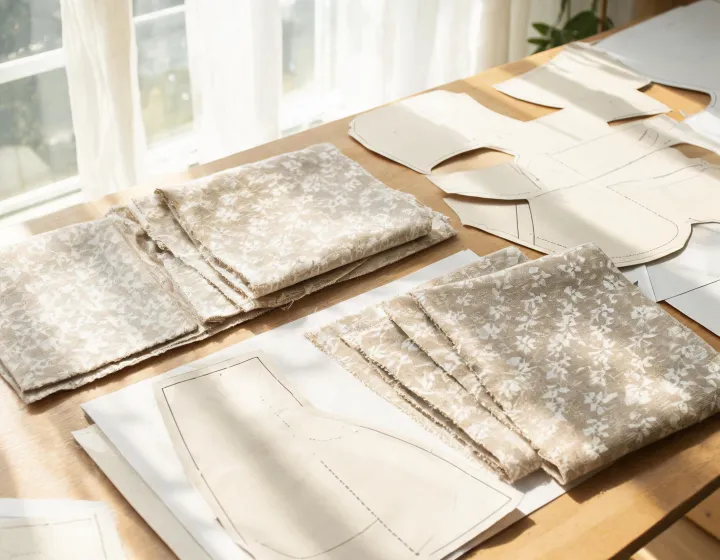
Translate the garment into acceptance questions
Shirts and lightweight layers
Describe opacity, drape and skin-contact expectations with a reference rather than a fabric-family label. Request composition, yarn count, weave, weight and usable width. An illustrative brief might state 160 g/m² and 140 cm usable width; these are example request fields, not stocked specifications or performance results.
Dresses and coordinated separates
Ask how print repeat, motif direction and panel placement affect cutting yield. The same price per meter is not comparable if a directional print or narrower usable width changes the marker. Set a shade reference and ask whether separate colors or replenishment orders may come from different dye lots.
Print development and finishing
A strike-off should identify its linen ground, print process, finish and artwork revision. A lab dip addresses a color decision; it does not approve print registration. Keep the pre-production sample linked to the proposed bulk sequence so a changed softener, wash or finishing step triggers a visible review.
| Decision | Stock ground route | Custom development route |
|---|
| Construction | Evaluate the available specification against the garment | Ask for construction target, tolerance and development minimum |
| Print approval | Confirm that the strike-off uses the proposed stock article | Confirm ground approval before accepting the print reference |
| Comparable cost | Check usable yield, lot availability and print setup scope | Include development, sampling, testing and minimum-order exposure |
Neither route is inherently preferable: stock can simplify an aligned brief, while development can address an exact requirement with additional decisions. A low unit price may be attractive when scope is equal; delivered cost exposes excluded sampling, freight or testing.
For dimensional stability, colorfastness or tear strength, agree the test method, edition, conditioning, laundering or exposure conditions, specimen identity and acceptance threshold before commissioning a test. ASTM's textile standards index and AATCC's method listings help frame method questions; a listing is not a result. Numerical performance is not claimed here. A changed ground, finish or dye lot limits how an earlier sample can represent bulk.
Use the approval workflow and linen procurement brief to connect these questions to your RFQ.